" 1. Edit, as root, /etc/apt/sources.list and ensure that each line beginning with deb has another line below it that is identical except that deb is replaced with deb-src . Then run sudo apt-get update ."
How can I make this? This is my sources.list file:
#deb cdrom:[Linux Mint 20.2 _Uma_ - Release amd64 20210703]/ focal contrib main

# This system was installed using small removable media
# (e.g. netinst, live or single CD). The matching "deb cdrom"
# entries were disabled at the end of the installation process.
# For information about how to configure apt package sources,
# see the sources.list(5) manual.
What must I do? Cabbage requires latest version of csound…
thanks for you reply… this is the terminal output:
juspu:~$ sudo apt-get build-dep csound
[sudo] password for juspu:
Reading package lists... Done
E: You must put some 'deb-src' URIs in your sources.list
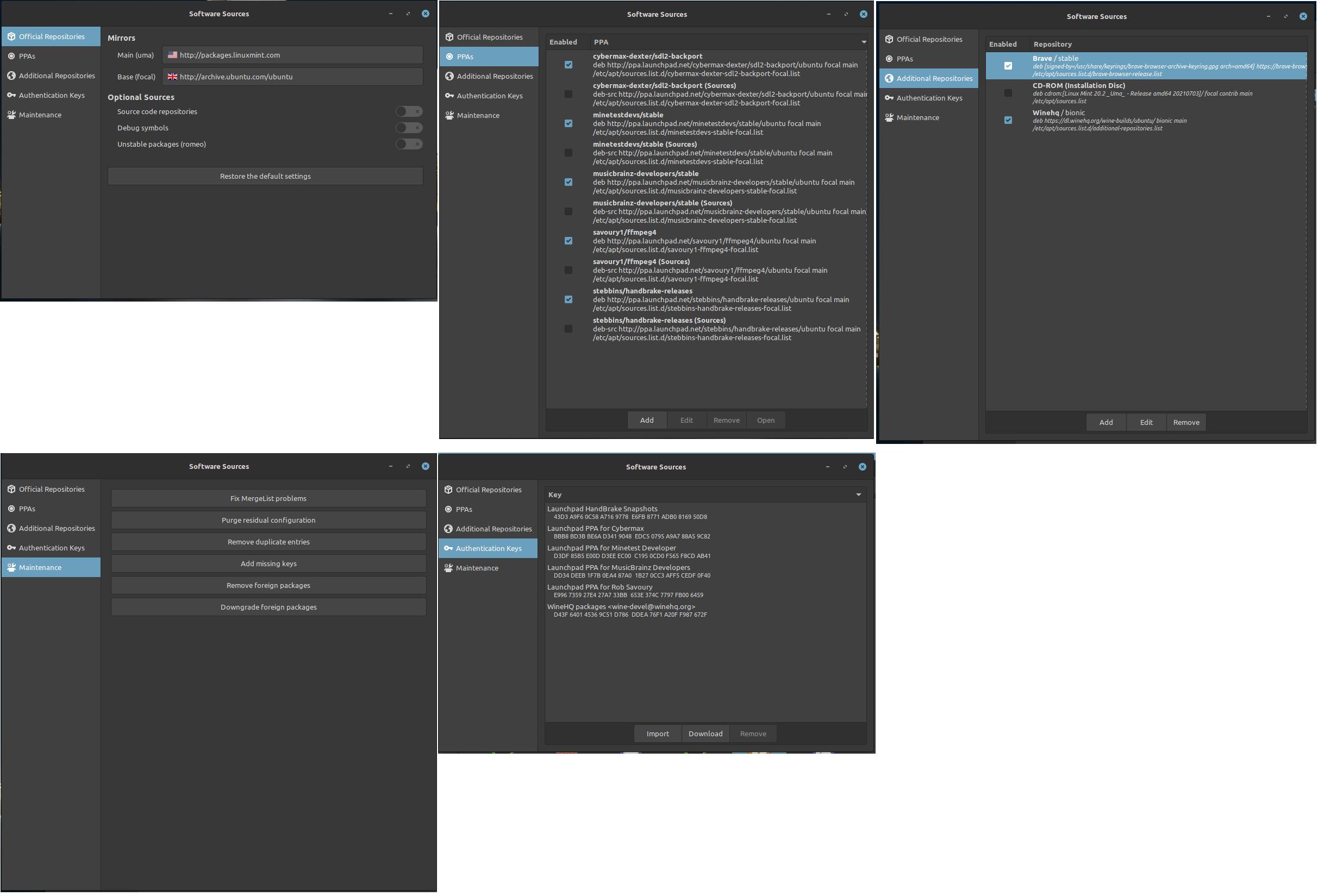
Have you modified this list before? Your Software Sources application is an interface to this list. If you open up, there should be a ‘Restore default settings’ checkbox somewhere. Can you try clicked that and seeing what happens?
No, this is a new Mint installation… What do you think I should do? Do you think it is possible to install csound? I found the “software Sources” application, but I have no idea what I need to do in there. I can share screenshots if you think it might help…
I clicked the ‘Restore default settings’ button, but the result is the same as before…
juspu:~$ sudo apt-get build-dep csound
[sudo] password for juspu:
Reading package lists... Done
E: You must put some 'deb-src' URIs in your sources.list
I guess the answer is in the sources.list file, where it tells us why it disabled the sources. Can you enable sources in your software sources application? Maybe send a screenshot
What about enabling source code repositories? have you ever run sudo apt-get update? That’s worth doing as well as it should update your sources, but I believe the software sources application does this whenever you make some changes there…
A quick google search seems to show that on Mint, the sources are written to this location /etc/apt/sources.list.d/. Can you run ls /etc/apt/sources.list.d/ to see what’s there? I tried Mint years ago because it looks great, but then remember getting frustrated with how it does things. So I went back to Xfce Ubuntu. Being one of the most popular distros, it’s quite easy to get help with.
I love Mint… if it goes, I’m happy, really. Otherwise I try to ask on the Mint forum why you can not install Csound… (from the software center it installs, but it is an old version)
I’m such a beginner!!! Just install it from software center:
juspu@juspu:~$ csound
time resolution is 1000.000 ns
0dBFS level = 32768.0
--Csound version 6.13 beta (double samples) 2020-02-10
[commit: none]
libsndfile-1.0.28
Usage:      csound [-flags] orchfile scorefile
Legal flags are:
--help      print long usage options
--version   print version details
-U unam     run utility program unam
-C          use Cscore processing of scorefile
-j N        use N threads in performance
-I          I-time only orch run
-n          no sound onto disk
-i fnam     sound input filename
-o fnam     sound output filename
-b N        sample frames (or -kprds) per software sound I/O buffer
-B N        samples per hardware sound I/O buffer
-A          create an AIFF format output soundfile
-W          create a WAV format output soundfile
-J          create an IRCAM format output soundfile
-h          no header on output soundfile
-c          8-bit signed_char sound samples
-8          8-bit unsigned_char sound samples
-u          ulaw sound samples
-s          short_int sound samples
-l          long_int sound samples
-f          float sound samples
-3          24bit sound samples
-r N        orchestra srate override
-k N        orchestra krate override
-K          do not generate PEAK chunks
-v          verbose orch translation
-m N        tty message level. Sum of:
              1=note amps, 2=out-of-range msg, 4=warnings
              0/32/64/96=note amp format (raw,dB,colors)
              128=print benchmark information
-d          suppress all displays
-g          suppress graphics, use ascii displays
-G          suppress graphics, use Postscript displays
-x fnam     extract from score.srt using extract file 'fnam'
-t N        use uninterpreted beats of the score, initially at tempo N
-t 0        use score.srt for sorted score rather than a temporary
-L dnam     read Line-oriented realtime score events from device 'dnam'
-M dnam     read MIDI realtime events from device 'dnam'
-F fnam     read MIDIfile event stream from file 'fnam'
-R          continually rewrite header while writing soundfile (WAV/AIFF)
-H#         print heartbeat style 1, 2 or 3 at each soundfile write
-N          notify (ring the bell) when score or miditrack is done
-T          terminate the performance when miditrack is done
-D          defer GEN01 soundfile loads until performance time
-Q dnam     select MIDI output device
-z          list opcodes in this version
-Z          dither output
--sched     set real-time priority and lock memory
              (requires -d and real time audio (-iadc/-odac))
--sched=N   set specified scheduling priority, and lock memory
              (requires -d and real time audio (-iadc/-odac))
flag defaults: csound -s -otest -b256 -B1024 -m135

Csound Command ERROR:    insufficient arguments
end of score.		   overall amps:      0.0
	   overall samples out of range:        0
0 errors in performance
Elapsed time at end of performance: real: 0.000s, CPU: 0.000s
juspu@juspu:~$
juspu@juspu:~$ sudo apt-get build-dep csound
[sudo] password for juspu:
Reading package lists... Done
Reading package lists... Done
Building dependency tree
Reading state information... Done
Some packages could not be installed. This may mean that you have
requested an impossible situation or if you are using the unstable
distribution that some required packages have not yet been created
or been moved out of Incoming.
The following information may help to resolve the situation:

The following packages have unmet dependencies:
 builddeps:csound : Depends: portaudio19-dev but it is not going to be installed
                    Depends: libstk0-dev but it is not going to be installed
E: Unable to correct problems, you have held broken packages.
juspu@juspu:~$
can I resove or do you say that it is better to change distribution?
yes, and the terminal response is wat I shared… needless to say the file sources.list I didn’t change it. But maybe it’s like you say: mint is not the right distribution for csound…
I don’t think mint is the wrong distro for Csound, it’s just a Debian based system, so it should build fine there. But I have no experience with it apart from a short stint many years ago. Did you have any luck getting help on the Mint forums about how to set up the software sources properly?
For anyone else reading this who might be having problems installing csound v6 on Mint, I built it from source as a dependency for ToneZ synth, but had to diverge from both sets of instructions.
Step 1 from the ToneZ README instructions:
Make sure to have csound v6 installed on your computer
I built csound from source following the instructions here for Ubuntu/Debian. Step 1 of the build instructions reads:
Edit, as root, /etc/apt/sources.list and ensure that each line
beginning with deb has another line below it that is identical except
that deb is replaced with deb-src. Then run sudo apt-get update.
However my sources.list in Mint is empty. I figured out you have to edit /etc/apt/sources.list.d/official-package-repositories.list instead. Then follow the rest of the instructions to build csound v6.
Now back to the ToneZ README instructions:
Copy the “Retornz” folder inside your $HOME directory
Easy enough.
Finally copy the .so and/or .vst3 plugin where your host can find
it
For myself on Mint, I had to copy the ToneZ_V2.vst3 directory to my /lib/vst3/ directory and then copy the ToneZ_V2.so file to /lib/lxvst/ directory.
Now everything sounds great but for some reason, the “Open”, “Folder”, and “Save” buttons seem to do nothing for me, so I have to cycle through the presets manually. If anyone knows how to fix that, feel free to let me know.
Thanks for this. I’m going to ping @Retornz and see if he picks up the scent. If not, you’ll find him on the ToneZ discord server. He’s very quick to answer questions there.